
EUCLID (Euclid University / Pôle Universitaire Euclide) is a treaty-based intergovernmental university established in 2008 by multilateral agreements among sovereign states. Its legal personality and university mandate are formally recognized under international law. This page clarifies EUCLID's precise relationship with the United Nations system, its verified status, observer privileges, and active engagement in UN processes.
Not a UN Specialized Agency or UN-Sponsored Institution
EUCLID is not a United Nations specialized agency, nor is it directly established or governed by the UN General Assembly.
It differs from:
- The United Nations University (UNU) (Tokyo) — the academic arm of the UN system.
- The University for Peace (UPEACE) (Costa Rica) — created by UN resolution.
Instead, EUCLID operates as an independent intergovernmental organization (IGO) with a full university mandate, created by its Participating States through registered treaties. It serves primarily civil servants, diplomats, and professionals from the Global South with advanced programs in sustainable development, international relations, global health, diplomacy, and related fields.
Verified, Registered, and Published Charter
EUCLID's founding treaties were verified, registered, and published by the United Nations Secretariat under United Nations Treaty Series (UNTS) certificates 49006 and 49007 (pursuant to Article 102 of the UN Charter).
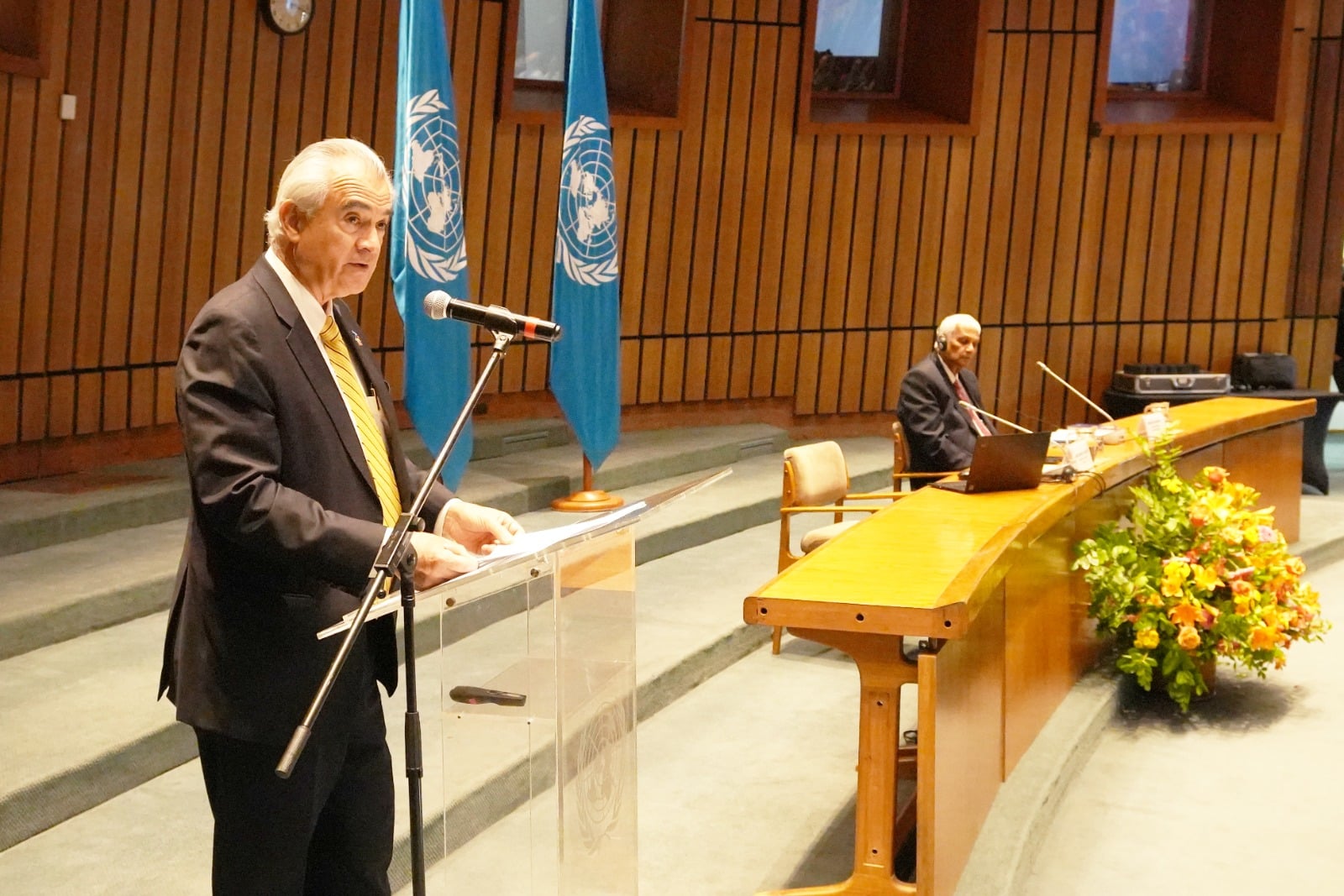
Photo above: the EUCLID Secretary-General (seated) as a keynote speaker at a UN/ECLAC conference
This registration grants EUCLID full international legal personality as a treaty-based institution. As an institution of higher learning, it is accredited by the Ministries of Higher Education of its headquarters states (Central African Republic and The Gambia, via the national NAQAA agency) and listed in the UNESCO International Association of Universities' World Higher Education Database (IAU WHED), the reference used by the UN system for credential evaluation.
Formal UN Recognition for Employment and Accreditation Purposes
In December 2012, the United Nations Office of Human Resources Management issued an official letter (Ref: 0218/RCA/MP/ONU-12) recognizing EUCLID as an accredited institution for UN employment purposes. The letter explicitly groups EUCLID with other recognized intergovernmental universities such as the United Nations University (UNU) and the European University Institute (EUI). This recognition remains valid and continues to affirm the legitimacy of EUCLID degrees within the UN system.
Intergovernmental Observer Status at the UNFCCC
EUCLID holds official intergovernmental observer status with the United Nations Framework Convention on Climate Change (UNFCCC).
Key recent participation:
- COP28 (2023, Dubai) — High-level delegation led by Professor Charalee Graydon.
- COP30 (2025, Belém, Brazil) — Official observer delegation; Professor Graydon published a detailed report on outcomes, with special emphasis on indigenous inclusion and climate justice.
This status allows EUCLID to participate directly in Blue Zone negotiations, side events, and high-level dialogues — a rare privilege for any university worldwide.
Intergovernmental Observer Status at the IPCC
EUCLID also holds official intergovernmental observer status with the Intergovernmental Panel on Climate Change (IPCC), the leading United Nations body for assessing the science related to climate change.
- EUCLID is formally listed among the 36 Intergovernmental Organizations (IGOs) granted observer status by the IPCC Panel.
- Focal Point: Dr. Klemens Katterbauer.
- EUCLID is the only university in the world to hold this distinguished intergovernmental observer status at the IPCC.
- The status was formally approved in 2025 following EUCLID's application and its prior accreditation with the UNFCCC.
This observer status enables EUCLID to attend IPCC sessions and plenary meetings, contribute to the global scientific dialogue on climate change, and support evidence-based policy recommendations through its academic programs in sustainable development and climate governance. It complements EUCLID's UNFCCC observer role, creating a unique dual presence in the two principal UN climate mechanisms.
High-Level Engagement at the United Nations General Assembly (UNGA)
In October 2025, during UNGA2025 in New York, EUCLID representatives (including Board of Advisors Member Ambassador F. Anderson and Oversight Council Chairman L. Cleenewerck) held high-level diplomatic meetings, including a notable encounter with His Excellency President Faustin-Archange Touadéra of the Central African Republic. These engagements reinforced EUCLID's institutional ties and commitment to multilateral cooperation.
Formal Relations with UN-Related and Regional Organizations
EUCLID maintains active, formal partnerships that further embed it within the broader UN ecosystem:
- Economic Community of West African States (ECOWAS) — 2009 Memorandum of Understanding; ECOWAS scholarship program and program accreditation support. EUCLID's English-language headquarters is in Banjul, The Gambia.
- International Anti-Corruption Academy (IACA) — Party to IACA's statutes alongside UN member states (IACA was initiated by the UN Office on Drugs and Crime).
- Association of Caribbean States (ACS) — Formal cooperation on regional development and diplomacy.
Academic and UN-Affiliated Memberships
EUCLID is a proud member in good standing of:
- Academic Council on the United Nations System (ACUNS)
- UN Academic Impact (UNAI)
- UN Principles for Responsible Management Education (PRME)
- International Association of University Presidents (IAUP)
- Association of African Universities (AAU)
These memberships require governmental endorsement and underscore EUCLID's recognized place in global higher education and multilateral affairs.
Conclusion
EUCLID occupies a unique and respected niche: a fully independent, treaty-based intergovernmental university with clear UN registration, formal recognition, UNFCCC observer status, and active participation in UNGA and COP processes. It is not part of the UN bureaucracy, yet it is fully integrated into the international legal and academic framework that supports the UN's mission.
This status enables EUCLID to deliver rigorous, globally relevant graduate education while contributing directly to multilateral dialogue on sustainable development, climate action, peace, and governance.