EUCLID is not an acronym—it is the official short form of the institution's name. The full official names are Euclid University in English and Pôle Universitaire Euclide in French.
The institution was deliberately named after the ancient Greek mathematician Euclid (c. 300 BC), often called Euclid of Alexandria to distinguish him from Euclides of Megara. Euclid's name in Greek (Εὐκλείδης) means "glorious" or "renowned." He is universally regarded as the "father of geometry" for compiling and systematizing mathematical knowledge in his seminal work, Elements (Στοιχεῖα). This 13-book treatise served as the primary textbook for mathematics—especially geometry—for over 2,000 years, from its publication until the late 19th century. Elements is famous for its rigorous axiomatic-deductive method: starting from a small set of self-evident postulates and definitions, Euclid proved hundreds of theorems through logical steps. This approach profoundly influenced Western thought, philosophy, and even figures like Abraham Lincoln, who studied Euclid's proofs as a model for clear reasoning and legal argumentation.

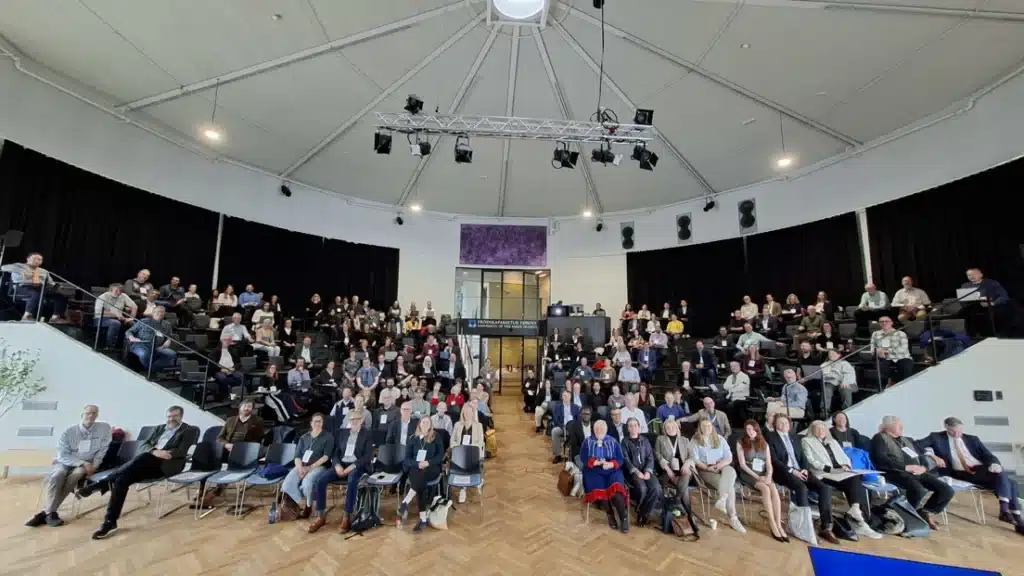
Why name a modern intergovernmental university after an ancient geometer? The two founding rectors—Professor Faustin-Archange Touadéra (then Rector of the University of Bangui, later Prime Minister and now President of the Central African Republic; photo below with EUCLID's Oversight Council Chairman) and Professor Rodoumta Koina (Rector of the University of N'Djamena, Chad)—were both mathematicians. They chose the name for three explicit reasons, as stated on the official site:
- The founding rectors were mathematicians.
- Euclid's writings center on proof and sound reasoning.
- Euclidean and non-Euclidean geometries relate directly to the ability to establish and challenge major paradigms.
This naming reflects EUCLID's core educational philosophy: rigorous, evidence-based analysis combined with the courage to question and innovate beyond established frameworks—especially vital in intergovernmental diplomacy, sustainable development, and global problem-solving.

Expanding the Topic: Euclidean vs. Non-Euclidean Paradigms
The institution's name page specifically highlights "Euclidean and non-Euclidean geometries" as a metaphor for paradigm establishment and paradigm disruption. This is not just historical trivia; it encapsulates EUCLID's approach to higher education and global thought leadership.
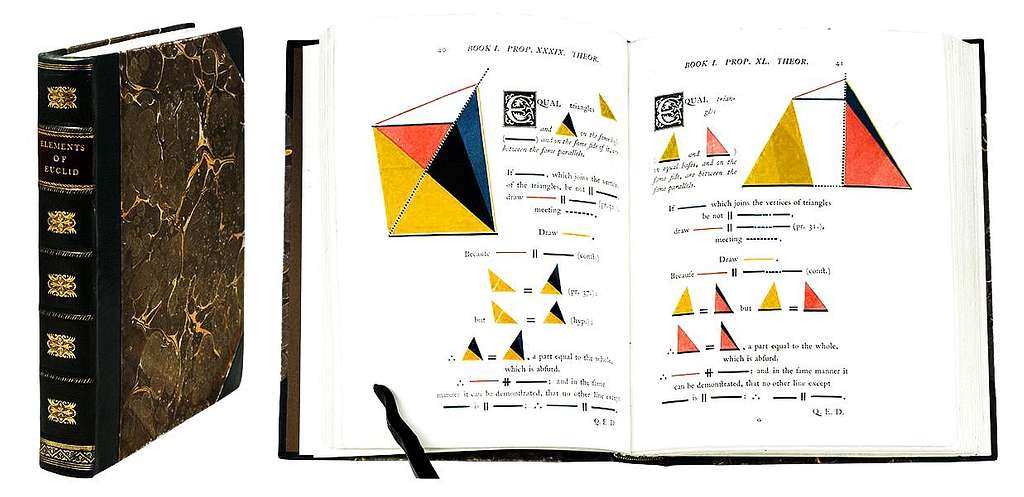
Euclidean Geometry: The Paradigm of Certainty and Deduction
For over two millennia, Euclidean geometry defined mathematical and scientific thinking. It rests on five postulates (axioms), the most famous being the parallel postulate (fifth postulate): through a point not on a given line, exactly one parallel line can be drawn.
In Euclidean space:
- Parallel lines never meet.
- The sum of angles in a triangle is exactly 180°.
- Space is "flat" and intuitive.
This framework became the paradigm (in Thomas Kuhn's sense) for Western science, education, and even philosophy (e.g., Immanuel Kant viewed Euclidean space as an a priori truth of the human mind). It symbolized absolute certainty derived from logical proof—exactly what EUCLID the university seeks to instill in its students: clear reasoning, verifiable conclusions, and intellectual discipline.
Non-Euclidean Geometry: The Paradigm Shift
In the 19th century, mathematicians like Carl Friedrich Gauss, Nikolai Lobachevsky, and Bernhard Riemann challenged the parallel postulate, proving that consistent alternative geometries exist when it is replaced:
- Hyperbolic geometry (Lobachevsky/Bolyai): Through a point not on a line, infinitely many parallels exist. Space is "saddle-shaped"; triangle angles sum to less than 180°.
- Elliptic/spherical geometry (Riemann): No parallel lines exist (all lines intersect). Space is curved like a sphere; triangle angles sum to more than 180°.
These geometries were initially seen as mathematical curiosities. Then, in 1915, Albert Einstein's general theory of relativity showed that non-Euclidean (specifically Riemannian) geometry describes physical reality: gravity curves spacetime. What was once "common sense" (flat Euclidean space) was overturned by evidence from physics.
Philosophical and educational implications (the core reason for EUCLID's naming):
- Paradigms are not eternal truths—they can be established through rigorous proof (Euclidean) and productively challenged when new evidence or perspectives arise (non-Euclidean).
- This duality encourages intellectual humility and creativity: master the rules, then know when and how to transcend them.
- In today's world of complex global challenges (climate change, geopolitical shifts, technological disruption), EUCLID applies this mindset. Students learn sound reasoning and evidence-based analysis while being equipped to question outdated assumptions in international law, sustainable development policy, and diplomacy.
By invoking both geometries, EUCLID signals that its graduates should be:
- Grounded in classical standards of proof and logic.
- Bold enough to drive paradigm shifts—much like how non-Euclidean geometry enabled modern physics, or how intergovernmental universities challenge traditional models of higher education.
In Summary: A Name That Embodies a Mission
EUCLID's name is far more than symbolic. It honors a mathematician whose work defined logical reasoning for centuries while embracing the revolutionary insight that even the most enduring paradigms can—and sometimes must—evolve. Rooted in the vision of two mathematician-rectors and operating as a treaty-based intergovernmental university, EUCLID continues this legacy today: delivering rigorous, globally recognized graduate education that prepares leaders to both uphold sound governance and innovate beyond conventional thinking.