An Intergovernmental institution under
United Nations Treaty Series 49006 / 49007

EUCLID Faculty Profiles

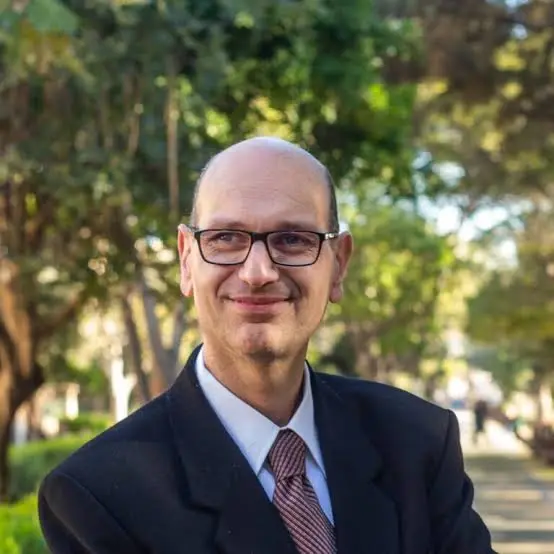
Amb. Prof. George Said-Zammit

Professor of Social Sciences

Prof. George Said-Zammit is a Professor of Social Sciences at EUCLID (Euclid University). He was born in Malta in 1969, holds a BA from the University of Malta, an MA in Archaeology from Durham University (1994), and a PhD in Archaeology and Anthropology from Leiden University (2016). In addition to his academic roles, he is a distinguished Maltese diplomat, having served as the Ambassador to the Republic of Georgia (2021) and later as the Ambassador of Malta to the State of Kuwait (2023). He is also a Fellow of the Society of Antiquaries and the Royal Anthropological Institute. His professional career includes 33 years in the Maltese education sector, where he served as Director of Examinations and National Coordinator for the Council of Europe's Human Rights Education Programme, before transitioning to senior diplomatic positions.

At EUCLID, Prof. Said-Zammit's teaching focuses on the interconnected fields of Anthropology, Social Sciences, and Diplomacy. His pedagogical approach is interdisciplinary, aiming to provide students with a comprehensive understanding of human societies, cultural evolution, and international relations. His teaching is enriched by his extensive background in both statecraft and archaeology, bridging theoretical academic study with practical diplomatic experience.
đź“… Last updated:

Research & Interests:

Prof. Said-Zammit has authored numerous academic monographs and scholarly papers. His research focuses on Maltese archaeology, particularly the evolution of domestic and social spaces. His key works include Houses and Domestic Space in Seventeenth and Eighteenth Century Hospitaller Malta (Routledge) and The Development of Domestic Space in the Maltese Islands from the Late Middle Ages to the Second Half of the Twentieth Century (Archaeopress, 2016). He also authored Population, Land Use and Settlement on Punic Malta: A Contextual Analysis of the Burial Evidence (BAR Publishing, 1997). Additionally, he has contributed chapters to volumes such as The Military Orders, Vol. 7: Piety, Pugnacity and Property

Faculty Relationships at EUCLID:

At EUCLID, faculty interactions are intentionally personal, responsive, and relationship-centered. Students connect with professors primarily through direct email and scheduled Zoom sessions, creating regular opportunities for substantive dialogue rather than one-way communication.

Professors respond promptly to emails with detailed, constructive feedback and are readily available for one-on-one Zoom meetings to discuss coursework, research direction, thesis development, or career goals. These interactions are not limited to academic questions; they often evolve into ongoing mentorship relationships where faculty serve as professional and academic role models. Students benefit from professors’ real-world experience in global affairs, sustainable development, diplomacy, and related fields, gaining practical insights that complement the formal curriculum.

The emphasis is on genuine relationship building. Many students develop lasting professional connections with their professors, who actively support their academic progress and post-graduation objectives. This accessible, human-centered faculty model is a defining feature of the EUCLID experience, designed to foster intellectual growth, professional maturity, and meaningful scholarly collaboration.

Office: Malta

EUCLID Report on visits to Rwanda and Ethiopia

EUCLID (Euclid University) today released details of the recent official mission undertaken by Professor Laurent…

President Touadéra presides over 2025 convocation

Bangui, Central African Republic – November 6, 2026 – His Excellency Professor Faustin-Archange TouadĂ©ra, President…